
We heard from two escapee activists at the General Assembly.
Gyuri Kang’s Statement
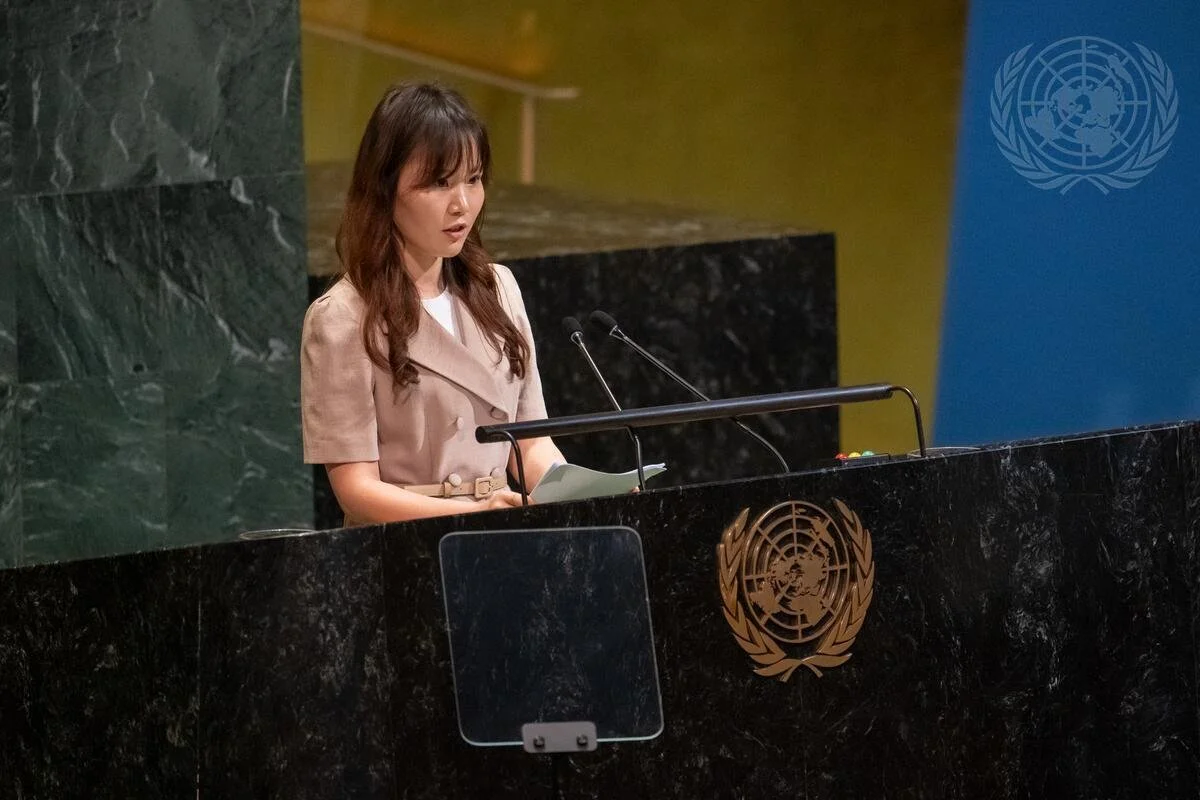
In October 2023, I escaped from North Korea to South Korea on a small, 10-meter wooden boat with my mother and aunt. It was a miracle that my family made it safely.
During the COVID-19 pandemic, I recall seeing many fishing boats begin to disappear in the coastal city of Wonsan where I lived. Many of those boats were probably either captured by North Korea’s patrol vessels or were lost at sea while trying to flee to South Korea. However, there are still millions of North Koreans who are deprived of fundamental human rights; who have no access to any information about the outside world; who believe that they have no choice but to live under three generations of the Kim dynasty’s personality cult.
My entire family was banished from Pyongyang to the countryside when I was five years old because my grandmother was caught practicing folk religion. The only religion or belief permitted in North Korea is the Juche ideology, a pseudo-religion that worships the Kim family and justifies their hereditary rule. There have even been executions for religious or “superstitious” activities. Even at such a young age, I could not understand why we had to suffer persecution on religious grounds.
Living in the countryside, I witnessed and experienced the harsh life of ordinary North Koreans. Unlike in the capital city of Pyongyang, there were no food rations or electricity available in the rural regions of the country.
At first, I made a living by teaching table tennis or ping pong, which is a popular pastime for the government and party officials. Then, I heard that I could make a lot of money by becoming an owner of a fishing boat. So, I borrowed money from my mother to buy a small wooden fishing boat.
However, the life of a woman as a fishing boat owner in North Korea was difficult. I realized that, in North Korea, ordinary people work hard only to see the gains stolen by the officers. Young people like me found no hope for justice or reform because the very people who were supposed to combat corruption were the ones committing it.
However, I was lucky to have access to information from the outside world. At first, I was given a USB containing South Korean dramas. I could not stop watching South Korean dramas or South Korean TV broadcasts even though getting caught would have resulted in harsh punishment. I found them so refreshing and more credible than North Korea’s state propaganda. In particular, the stories that anyone fleeing North Korea would be welcomed helped me decide to undertake the dangerous journey.
The North Korean authorities are keenly aware of the impact of outside media.
They want to keep the North Korean people in the dark and prevent them from daring to even dream of freedom.
The COVID-19 lockdowns gave them a perfect excuse and opportunity. Even as the North Korean people were suffering from hyperinflation, economic hardship and widespread hunger arising from the loss of trade with China, the North Korean authorities used the occasion to eradicate South Korean cultural influence.
After the pandemic began, North Korean young people were forced to memorize the newly passed Reactionary Thought and Culture Rejection Law, the Youth Education Guarantee Law and the Pyongyang Cultural Language Law.
Three of my friends were executed, two of them in public, for “distributing” South Korean dramas. One of them was only 19 years old. At first, I could not believe this. Their “crime” was watching South Korean dramas and passing them on to their friends, which made them guilty of “distribution”, which carries the death penalty. It was as if they were guilty of drug distribution or human trafficking.
Still, I am living proof that even within a totalitarian system like North Korea, information can spread and inspire people to yearn for freedom.
There's a saying that when your hand is on a hot furnace, one second feels like an hour. The North Korean people are living as if in a furnace, with burns covering their bodies. They also suffer mental scars from the daily human rights abuses and violations they endure.
The exploitation of the North Korean people is now a threat to international peace and security. Even in the midst of these difficult circumstances, the people of North Korea should be encouraged to know that the world cares about their human rights—which everyone should enjoy without distinction as to race, sex, language, or religion under the UN Charter.
I hope that my speech today awakens the North Korean people and helps to reorient their inner human compasses, skewed by the Juche magnetic field for decades, to point in the direction of freedom.
Thank you.
Eunju Kim’s Statement
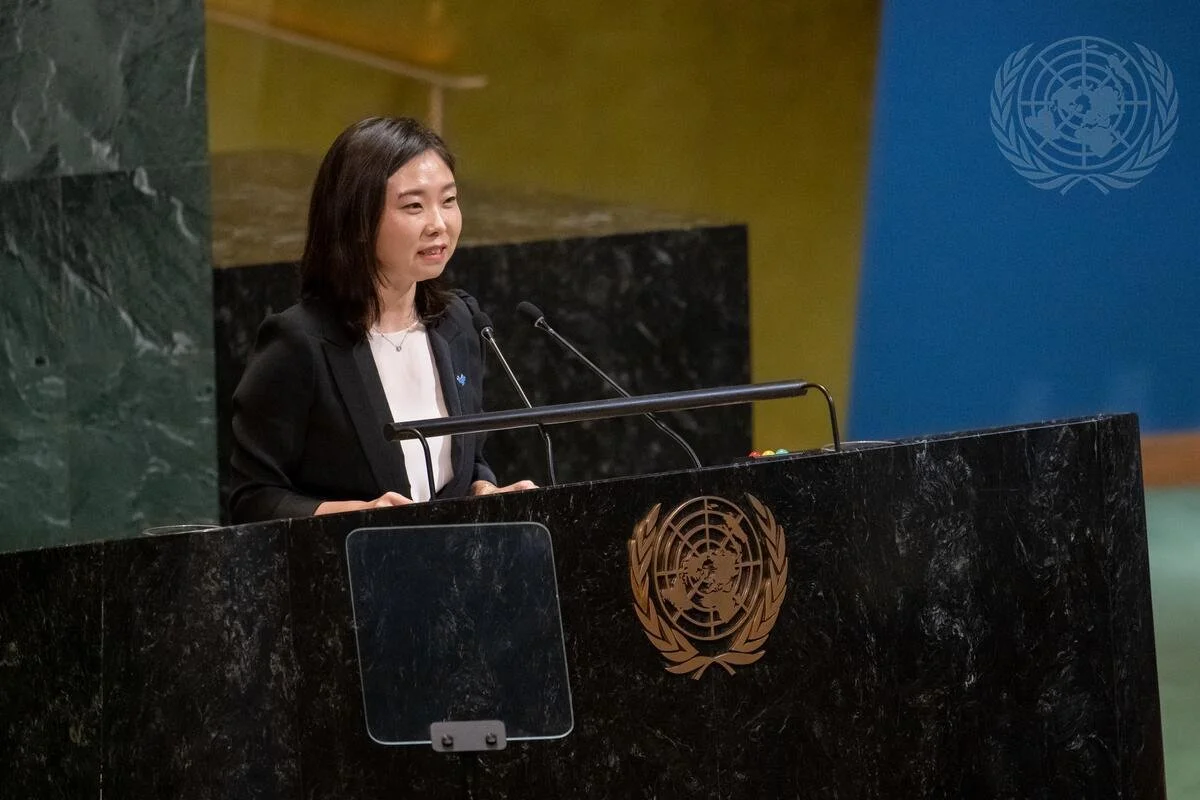
My name is Eunju Kim. I am a North Korean defector and a human rights advocate. Today, I’m here to speak for the many people who are still suffering under the North Korean regime.
In North Korea, my father died of starvation. One day, my mother and sister left to find food, and I was left behind – just eleven years old - waiting alone in the dark each night. I would count from one to one hundred, believing that if I finished counting, my mother would walk through the door. After six days with no food, I wrote what I believed would be my final words — not because I was afraid of dying, but because I felt the pain of being abandoned.
But I survived.
When my mother finally returned, she said -“If we’re going to die anyway, better to be shot crossing the Tumen River than to starve here.” So we escaped North Korea, simply hoping to find something to eat. But on our first night in China, my 14-year-old sister was kidnapped, sexually abused, and left on the roadside. Later, my mother, sister, and I were sold for only 2,000 yuan — less than 300 U.S. dollars.
This wasn’t just my family’s story. Many others face the same harsh reality under North Korea’s regime.
Even today, people in North Korea are starving. Women and girls are trafficked and abused in China. Thousands of defectors live in constant fear of forced repatriation. And North Korea’s human rights violations are becoming more systematic, organized – and spreading beyond its borders.
Today, young North Korean soldiers are caught up in a new kind of modern-day slavery — sent to fight in Russia’s war in Ukraine. They have no idea where they are, whom they’re fighting against, or why. Their lives have become a way for the Kim Jong-un regime to make money, while their parents, left behind in North Korea, are forced to endure the unbearable pain of losing their sons as cannon fodder on foreign battlefields. No amount of military aid from Russia can ease the grief of parents who have lost their sons. North Korea’s involvement in Russia’s war is not only a grave human rights violation, but also a serious threat to international peace and security. This is a new — and unacceptable — form of human trafficking in our modern world.
Such systematic abuses constitute crimes against humanity under international law. Kim Jong-un, as the ultimate authority of this regime, must be investigated and held accountable by the International Criminal Court. In this regard, it is encouraging that the Council of Europe pushing to establish a special tribunal to hold Russia accountable for its crime of aggression in Ukraine. This could also make it possible to prosecute Kim Jong-un and his military leadership. In addition, I would like to urge the European Union and other nations to consider creating a North Korean Human Rights Law or appointing a Special Ambassador dedicated only to North Korean Human Rights issues. This would strengthen accountability for Kim Jong un’s regime.
Silence is complicity.
As we have seen through North Korea’s involvement in Russia’s war in Ukraine, the North Korean human rights issue is no longer just a matter for the North Korean people. Anyone in the world could be the next victim.
Please do not turn away from the innocent lives being lost — in North Korea and elsewhere. Stand firm against the regime’s systematic atrocities. Restoring human rights in North Korea is not just about helping its people survive. It is about defending global peace — and upholding the dignity of all humanity.
One day, I hope to return to my hometown, hand in hand with my children — to show them a North Korea not defined by fear, but filled with beauty, freedom, and hope.
If we raise our voices, If we take action,
That day will come — sooner than we imagine.
And to those who are struggling right now just to survive, Our solidarity can be the very hope that saves their lives. Thank you.
